Madonna of Humility Crowned by Two Angels
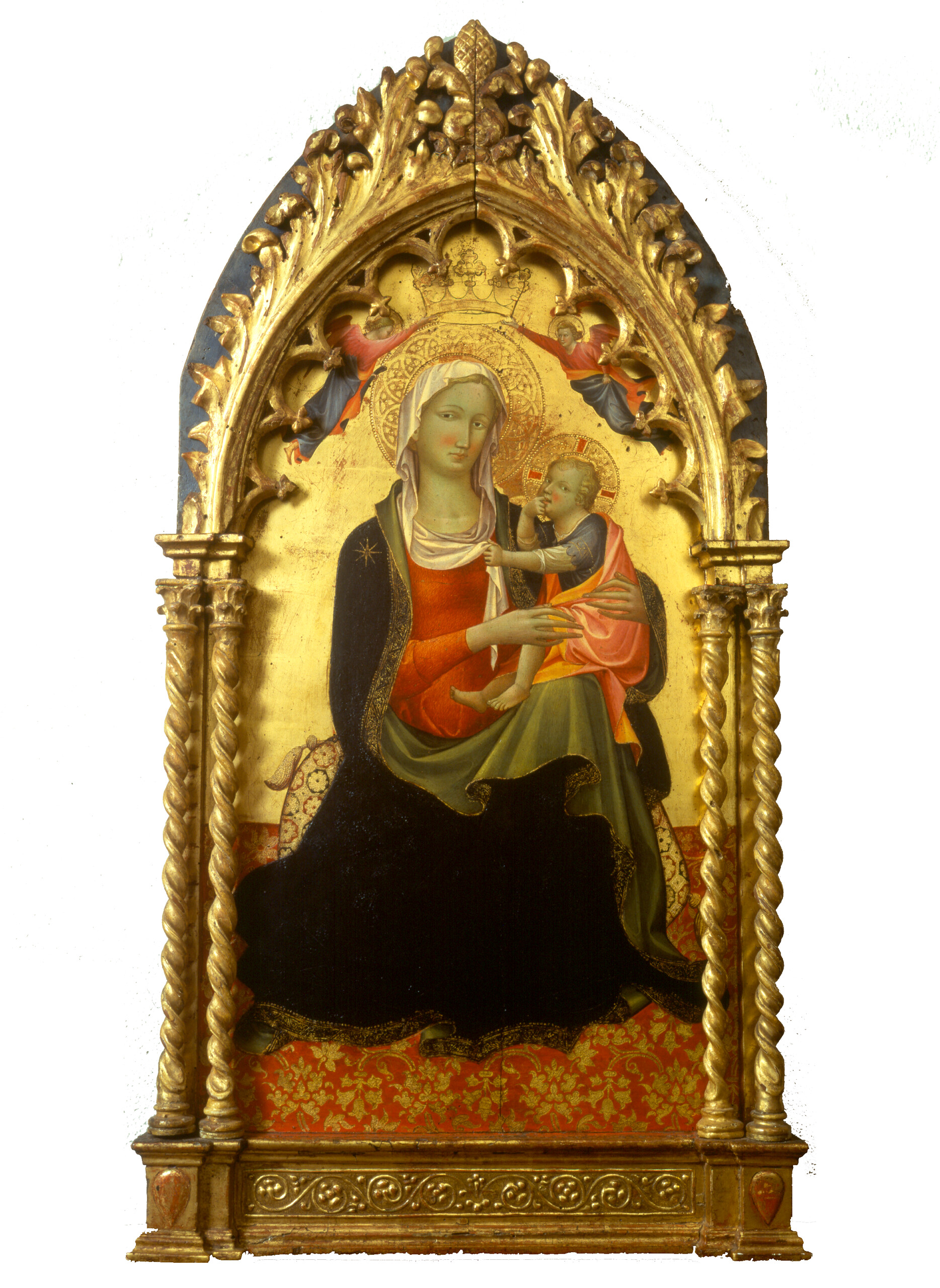
Intended to adorn the pillar of a church or the altar of a small noble chapel, the panel represents the Madonna of Humility, with the Virgin sitting on the ground, on a precious cushion, while she is crowned by two angels in flight. This rare iconographic variant known as Regina humilitatis had a limited diffusion and finds its most illustrious precedent in Simone Martini. The work, which can be dated around the middle of the first decade of the 15th century, is characterized by the great richness of the decorative repertoire, the brilliant chromaticism, the elegance of the line and the intimate and colloquial tone given by the tender gesture of the Child, who grasps his mother’s veil and sucks his finger. The work is part of the Alberto Crespi Collection, donated to the Museum in 2000.
Audio
Artwork details
- Artist:
- Gherardo di Jacopo Neri, detto Starnina (Firenze, documentato dal 1387 - morto nel 1413)
- Title:
- Madonna of Humility Crowned by Two Angels
- Date:
- c. 1405
- Medium and technique:
- Tempera on panel
- Dimensions:
- 117,2 × 62,9 × 8,5 cm (con cornice); 79 × 52 cm (superficie dipinta)
- Inventory:
- MD 2000.018.020
- Location
-
Location: Alberto Crespi Gold-Ground Collection, first floor
The Gold-Ground Collection comes from the collection of Alberto Crespi (1923–2022), a distinguished Milanese jurist and discerning collector. Donated to the Diocesan Museum in 2000, even before its inauguration in 2001, it reflects the informed spirit of collecting in Lombardy, which has always embraced artistic traditions beyond local production. The forty-one panels, made between the fourteenth and late fifteenth centuries, mostly in Tuscany, particularly Florence, and Umbria, but also in Venice and, in one case, Lombardy, illustrate key stages in the development of Italian painting. Some are small works intended for private devotion, while others retain their original frames. Most are surviving elements of important polyptychs made for altars in churches or private chapels. At the donor’s express wish, the gallery was designed by the architect Giovanni Quadrio Curzio.
Related artworks