Saint Cecilia
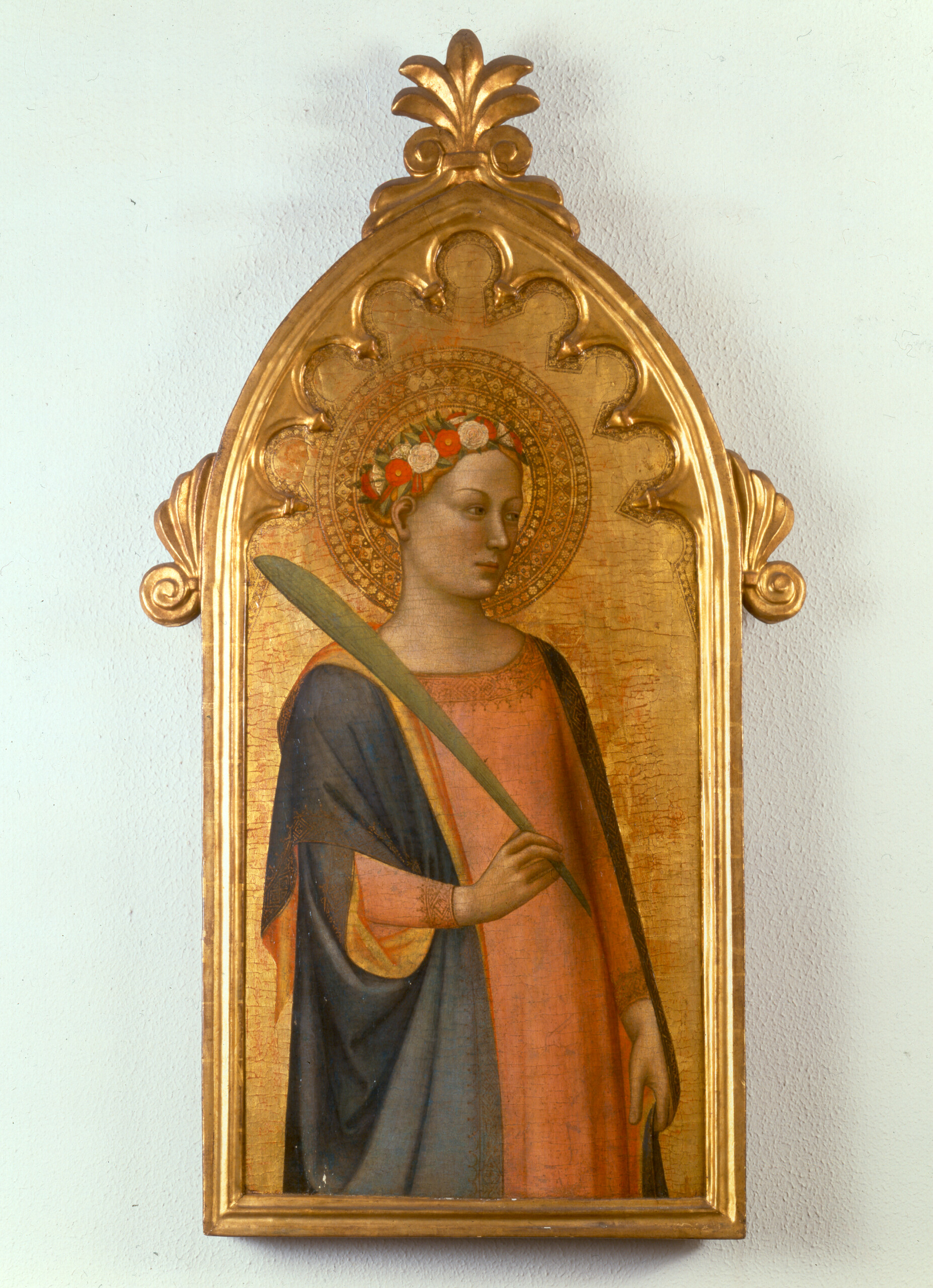
The panel was certainly part of a polyptych created by Bernardo Daddi around the third decade of the fourteenth century for the chapel of Saints Bartolomeo and Lorenzo in the Florentine church of Santa Maria del Carmine. Enclosed in a modern frame, Saint Cecilia is facing right, with a gray-blue cloak with yellow lapels that stand out on the pink dress, while in her right hand she holds the long and tapered palm of martyrdom. The artist gives an appearance of refined elegance to the image of the saint, cut out on the gold background by a clear outline drawing: the face with a gentle expression is delicately modeled and surrounded by a garland of lush red and white flowers. The work is part of the Alberto Crespi Collection, donated to the Museum in 2000.
Audio
Artwork details
- Artist:
- Bernardo Daddi (attivo a Firenze dal 1320 ca. al 1348)
- Title:
- Saint Cecilia
- Date:
- c. 1320-1330
- Medium and technique:
- Tempera on panel
- Dimensions:
- 89, 5 × 49,5 (con cornice), 71 × 33,5 cm (superficie dipinta)
- Inventory:
- MD 2000.018.022
- Location
-
Location: Alberto Crespi Gold-Ground Collection, first floor
The Gold-Ground Collection comes from the collection of Alberto Crespi (1923–2022), a distinguished Milanese jurist and discerning collector. Donated to the Diocesan Museum in 2000, even before its inauguration in 2001, it reflects the informed spirit of collecting in Lombardy, which has always embraced artistic traditions beyond local production. The forty-one panels, made between the fourteenth and late fifteenth centuries, mostly in Tuscany, particularly Florence, and Umbria, but also in Venice and, in one case, Lombardy, illustrate key stages in the development of Italian painting. Some are small works intended for private devotion, while others retain their original frames. Most are surviving elements of important polyptychs made for altars in churches or private chapels. At the donor’s express wish, the gallery was designed by the architect Giovanni Quadrio Curzio.
Related artworks