Exhibition
Nothing is known about the original provenance of this painting, which arrived after the Napoleonic suppressions in the Archbishop’s Picture Gallery and is generally not visible to the public.
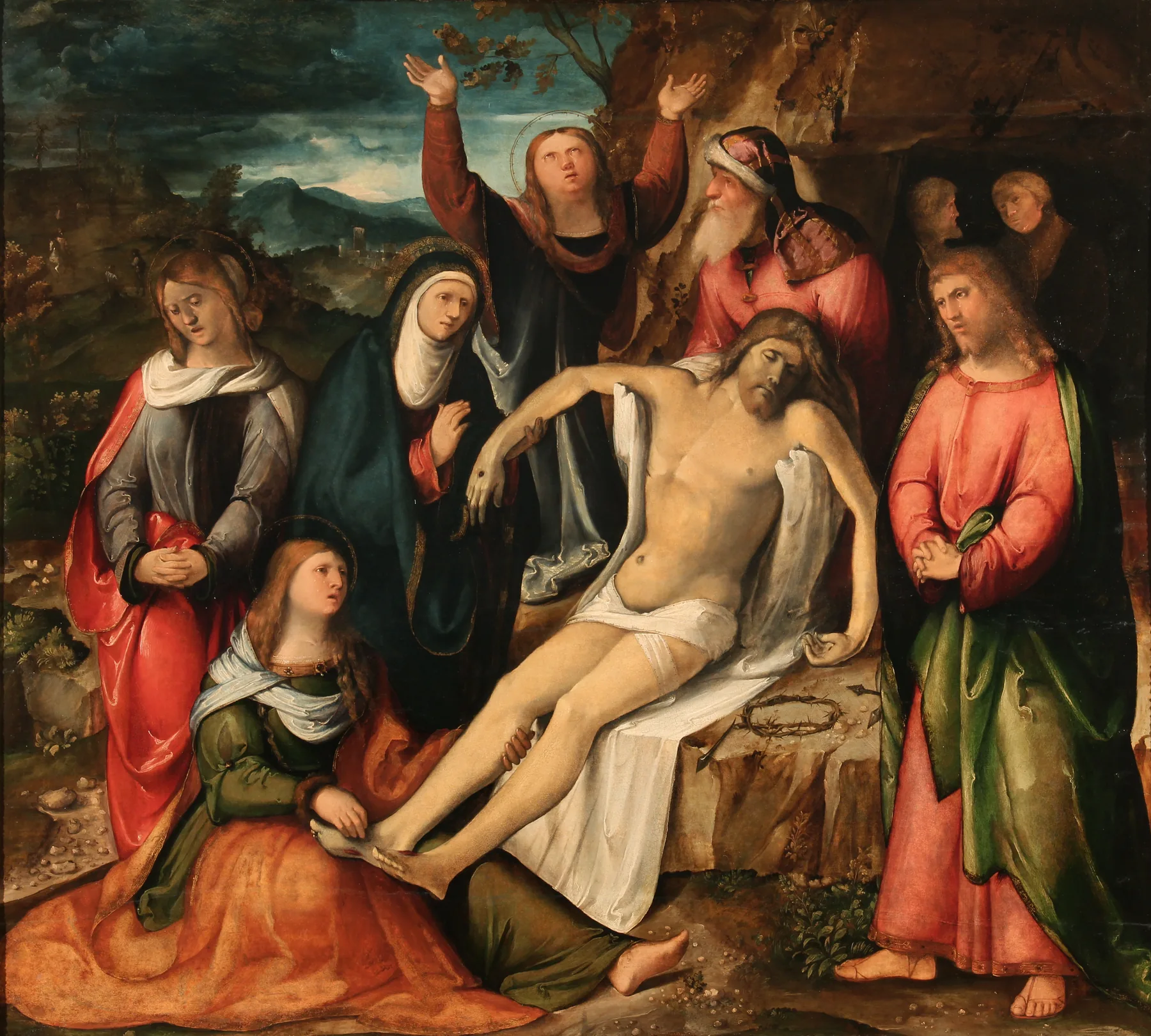
The work is unanimously referred by critics to the Cremonese painter Altobello Melone (Cremona 1490/91 – before 1543), trained between his hometown and Venice, and active above all in Brescia, where he compared himself with the painting of Romanino, and in Cremona, where he worked, among other things, on the important cycle of the Cathedral at the end of 1516. Close to this decorative undertaking, the large panel on display here should also be referred to: characteristics of this phase are in fact the vibrant chromatic highlights, and the dense mixture, with almost incandescent effects of clear Titian derivation.
Compared to the Lamentation of Romanino once preserved in the church of San Lorenzo in Brescia (now Venice, Gallerie dell’Accademia), taken from Altobello in another version now in Brera (around 1510), in the panel of the Archbishopric the artist shows an evident openness to the influences of Northern European painting, from which the dramatic and expressive excitement of the figures derives. In particular, there is a precise recovery of the central part of the painting from the scene of a similar subject engraved by Dürer in the Little Passion of 1509-11. The backdrop to the excited and crowded scene is a dark and iridescent landscape.
The episode of the Lamentation, not narrated by the Gospels, is distinguished from the scene of the Deposition from the Cross but also from that of the Pietà, where the Virgin supports the body of Christ.
The theme was born with an above all devotional intent to encourage the faithful to meditate and contemplate Christ, who died for the salvation of men.
The subject, initially widespread north of the Alps, then also had great diffusion in Lombardy starting from the end of the fifteenth century, becoming in the needs of a devotional trend that was linked to the meditations of mystics, such as Pseudo Bonaventure and Saint Bridget of Sweden, who urged the identification of the faithful with the sufferings of Christ, as also occurred in sacred representations.
Traditional figures of the Lamentation are, in addition to Christ, the Virgin, Saint John, Joseph of Arimathea, Nicodemus, Magdalene and the Pious women.
The exhibition of the Lamentation of Altobello Melone, recently restored, is a real gift that Archbishop Delpini wanted to give to the Diocese as preparation for Easter. Starting from the precious panel, the Museum offers visitors a special journey through the works of the permanent collection dedicated to the Passion of Christ.