Exhibition
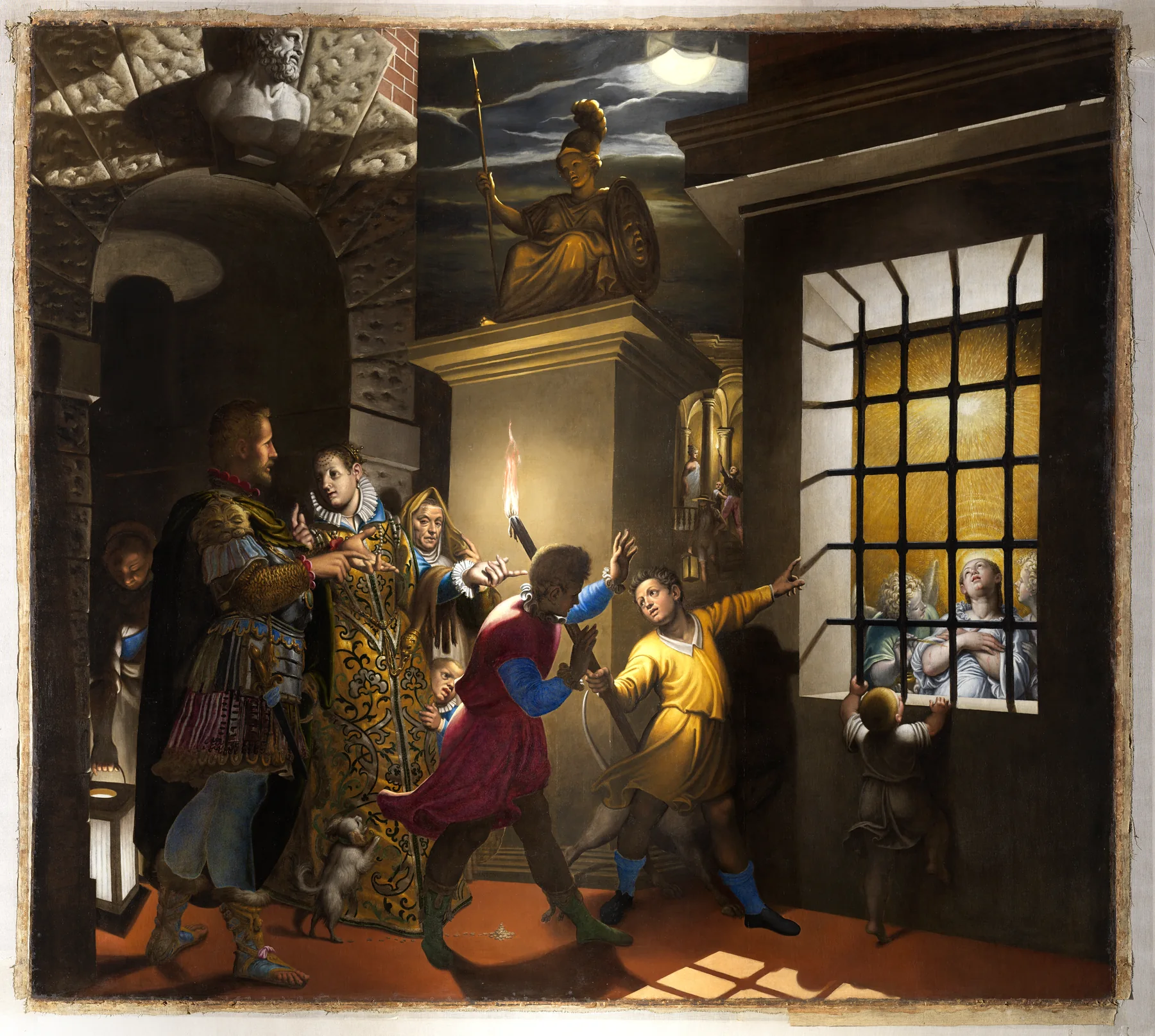
The monumental painting by Antonio Campi (1524-1587) depicting St. Catherine visited in prison by the Empress Faustina has arrived at the museum: a unique opportunity to admire the enormous canvas (400×500 cm) by the Cremonese master, before its relocation to the Milanese church, from which it originally came.
Conservator Delfina Fagnani explains that, during five months of work, “the usual preliminary scientific examinations immediately revealed highly interesting information about Antonio Campi’s technique: the diamond-weave canvas, the precise preparatory drawing and the surprisingly rich and varied palette. These findings were subsequently confirmed during the lengthy, repeated cleaning of the paint surface—the previous restoration dated back a century—both in the overall recovery of a distinctly sixteenth-century palette and in the striking modernity of the painted details, which Campi explores and emphasizes with focused attention and a playful spirit.”
Saint Catherine Visited in Prison by Empress Faustina belonged to a cycle painted in 1584. Together with its companion painting, the Martyrdom of the Saint, it decorated Countess Porzia Landi Gallarati’s family chapel, the first on the right in the Milanese church. The chapel also contained other works, including Gaudenzio Ferrari’s theatrical altarpiece, now in the Pinacoteca di Brera.
The scene simultaneously portrays two different episodes taken from the Golden Legend by Jacopo da Varazze: the visit of the empress Faustina to Saint Catherine of Alexandria in prison and that of the angels.
It is said that the young Catherine faced the emperor Maxentius in an attempt to convert him. He, unable to reply to the saint’s arguments on his own, sent fifteen philosophers to Alexandria, but Caterina managed to convert them. The emperor, angry, locked her in prison where she was miraculously cured by angelic figures. One night Faustina, wife of Maxentius, accompanied by Porphyry, captain of the guard and his retinue, went to visit the young woman in prison. Here, struck by the vision of angels surrounded by a supernatural light, all those present converted to Christianity.
The painting is characterized by an extraordinary and innovative use of light. The nocturnal setting of the scene favors, as Raphael had already suggested in the Liberation of Saint Peter frescoed in the Vatican rooms, the introduction of three different lights: the natural one (of the moon), the artificial one (of the lamp and the torch) and the supernatural one (of the angels and the saint).
The unification of two different episodes (the visit of the empress and, at the same time, the arrival of the angels) favors the play of light, which allows the slow revealing of the complex architectural structure expertly set also from a perspective point of view. In fact, the flashes of light lead the gaze to continue from the foreground to the distant loggia that can be glimpsed in the background.
The work arrives at the Museo Diocesano in Milan, after having been restored to its former splendor by the Credito Bergamasco Foundation – in five months of careful work carried out at Palazzo Creberg (Banco BPM Bergamo) by the restorer Delfina Fagnani-Sesti Restauri – and then exhibited to the public in the same location as part of its multi-year “Grandi Restauri” project.