Exhibition
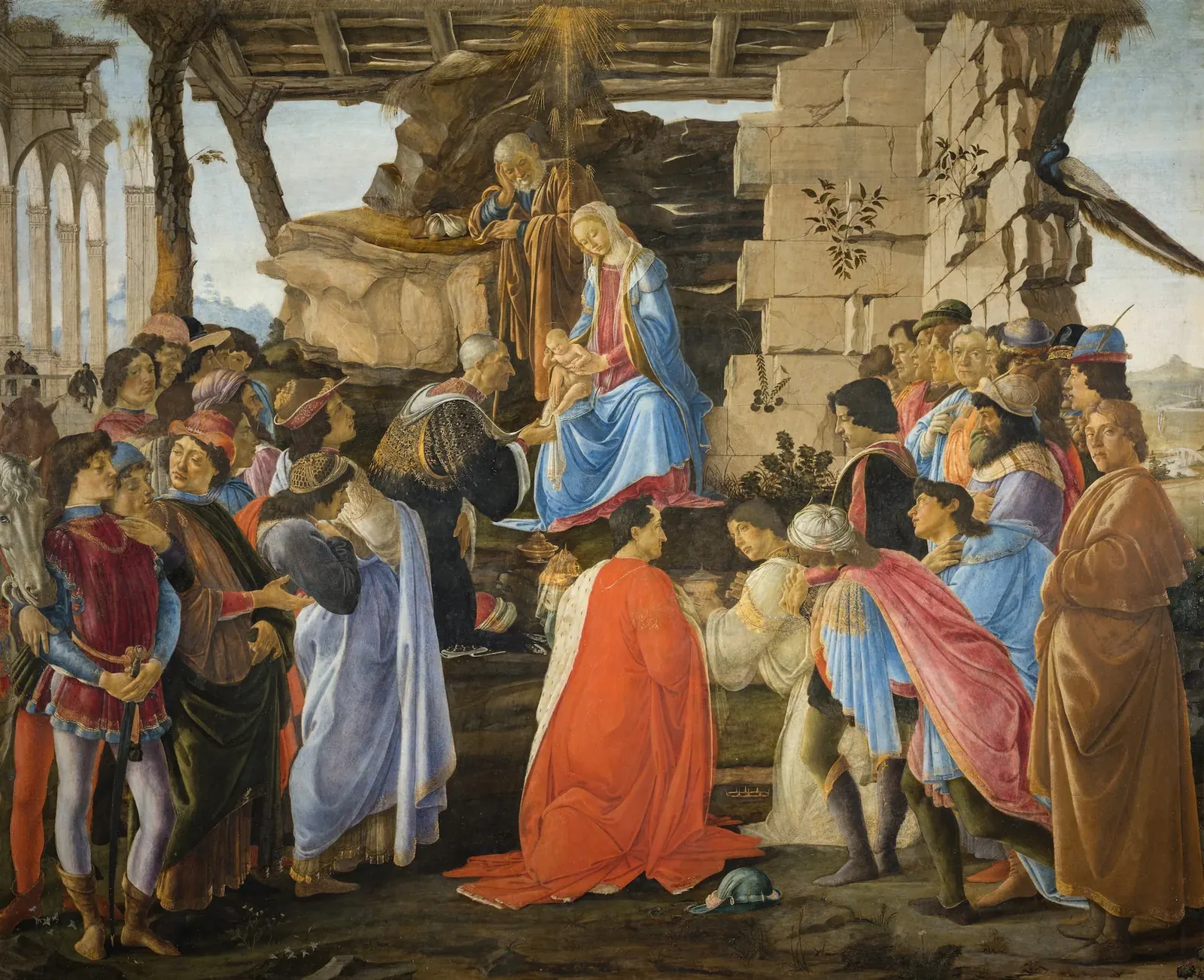
The Adoration of the Magi, one of the most fascinating and celebrated works by Sandro Botticelli (Florence, 1445 – 1510), a painter emblematic of the Italian Renaissance, is the A Masterpiece for Milan 2024 – an initiative now in its 16th edition – arriving from the Gallerie degli Uffizi in Florence.
The panel was created around 1475 for the chapel dedicated to the Magi in the church of Santa Maria Novella in Florence, commissioned from 1469 by the wealthy and ambitious businessman Gasparre del Lama. The subject – chosen both for reasons connected to the patron’s name, Gasparre, as the youngest of the Magi kings, and to pay homage to the Medici, fervent supporters of the Compagnia dei Magi based at San Marco in Florence – is treated by the artist with great originality, in a balanced composition, with the stable at the centre and the numerous figures arranged in an elaborate manner around it, in a great variety of poses and attitudes.
Within it, on a high plinth, beneath the rays of divine light, the Virgin and Child are depicted, while behind them Joseph appears in rapt concentration. To either side, divided into two ranks, is the procession of figures arriving in the train of the Magi, made up mostly of leading members of Florentine society at the time of the Medici’s rise, among whom the most important members of the family stand out. Botticelli himself is portrayed in the fair-haired young man on the right, shown in three-quarter view in a golden-yellow cloak, who seeks the viewer’s gaze.
The scene thus has the clear intention of underlining the patron’s political loyalty to the powerful Florentine family – he is represented in the white-haired man in the blue cloak on the right, turned towards the viewer – but also of acknowledging the divine value of the Medici’s earthly deeds.
The work highlights the painter’s skill as a portraitist, the vivid range of colour and the meticulous rendering of detail; also of great interest are the glimpses of landscape in the background, scattered with the ruins of a complex ancient building – a pretext for an exercise in perspective, but also an allusion to the end of the pagan world with the birth of Christ. On the crumbling wall, to the right of the composition, a peacock can finally be made out, a symbol of the Resurrection.