Exhibition
The Museo Diocesano Carlo Maria Martini in Milan, in collaboration with CAMERA – Centro Italiano per la Fotografia in Turin, presents the exhibition Dorothea Lange, which through 140 photographs celebrates the American photographer 130 years after her birth.
The journey begins in the 1930s and 1940s, when Lange became a crucial witness to some of the epoch-making events that would reshape the economic and social fabric of the United States – above all the Wall Street Crash – and which led her to abandon her work as a portraitist in order to document current events. Among these was the journey she undertook in 1935 with the economist Paul S. Taylor, whom she would marry some years later, to portray the dramatic living conditions of agricultural workers in the central regions of the country, struck between 1931 and 1939 by a severe drought, the phenomenon of the Dust Bowl – the recurring sandstorms also recounted by John Steinbeck in the novel The Grapes of Wrath (1939) and in its film adaptation by John Ford (1940), who drew inspiration precisely from the photographs taken by Lange.
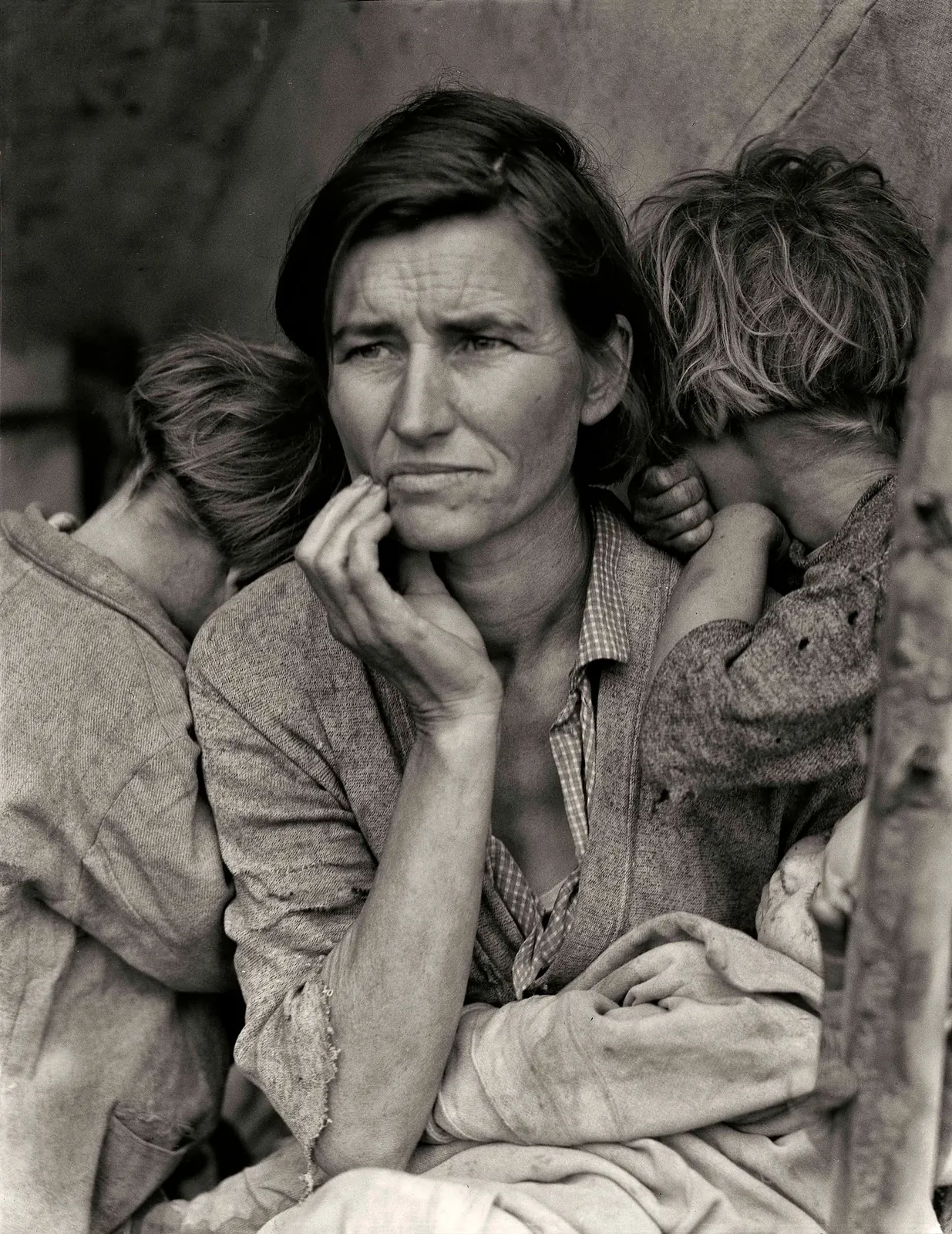
Her involvement in the government programme of the Farm Security Administration, set up to promote the policies of the New Deal, allowed Lange to travel across the United States and portray the places and faces of poverty. From the pea plantations of California to the cotton fields of the Southern states, where racial segregation gave rise to particularly degrading forms of exploitation, Lange took thousands of photographs, gathering stories and accounts set down in the detailed captions that accompany the works. This is the context in which Migrant Mother was created, the portrait of a young, desperate mother living with her seven children in a camp of tents and abandoned cars – an image that would go on to become iconic.
Another important group of photographs in the exhibition dates from the years of the Second World War – which for the United States began in 1941 with the Japanese bombing of Pearl Harbor – and is devoted to the Japanese-American population interned in prison camps by the US government following the country’s entry into the war.
In this case too, Lange worked on a government commission, even though she and her husband had publicly voiced their dissent: her photographs document the absurdity of a racist and discriminatory law and how it upended the lives of thousands of well-integrated people, forcing them to abandon their homes and their livelihoods.
Through her outstanding gifts as a reporter and portraitist, Lange was able to confront complex and dramatic situations, recounting the personal experiences and emotional lives of everyone she met along the way, while at the same time showing how political choices and environmental conditions can affect individual lives and change them drastically, still offering, today, food for thought on themes such as poverty, the climate crisis, migration and discrimination.