Exhibition
The exhibition, curated by Walter Guadagnini, director of CAMERA – Italian Center for Photography of Turin, with the patronage of the Municipality of Milan and with the support of Rinascente and T’A Milano, presents around 150 images by twenty of the most important masters of photography of the 20th century, which tell the news, history and customs of our country from the post-war period to today, through extraordinary views that capture the evolution of our country even in everyday life.
The exhibition opens with a tribute to the three founders of the Magnum agency (Henri Cartier-Bresson, Robert Capa and David Seymour) and their travels in Italy. From the beginning, the protection of copyright and respect for creativity and truth have been the cornerstones of the cooperative agency. The negatives, for the first time, therefore remain the property of the members, and the photographers are safe from the abuses of art directors and newspaper editors. A new freedom to act according to one’s personal style, interests and authorship is encouraged from the start. Thanks to these founding principles, Magnum achieved rapid success, which in just a few years welcomed numerous important names from the world of photography.
Organised for decades, the exhibition continued with the 1950s which saw the rebirth of the country, through the images of Elliott Erwitt who described the capital Rome, its beauties and its contradictions with an ironic gaze, and of René Burri who led the viewer inside the famous Picasso exhibition at Palazzo Reale in Milan in 1953, which hosted Guernica, the masterpiece of the Malagueño master, and Herbert List with the shots taken in Cinecittà, the “Hollywood on the Tiber”.
The sixties are relived through the photographs of Thomas Hoepker, Bruno Barbey and Erich Lessing which present, respectively, the triumph of Cassius Clay at the 1960 Rome Olympics, the enormous popular participation in the funeral of Palmiro Togliatti, and holidays on the Romagna Riviera during the period of the economic boom.
Ferdinando Scianna’s Sicily opens the section of the seventies, where we encounter the images of Leonard Freed on the social process that led to the referendum on divorce and of Raymond Depardon with the series on mental asylums, in the historical moment that marked the introduction into the Italian legal system of the Basaglia law which decreed their closure.
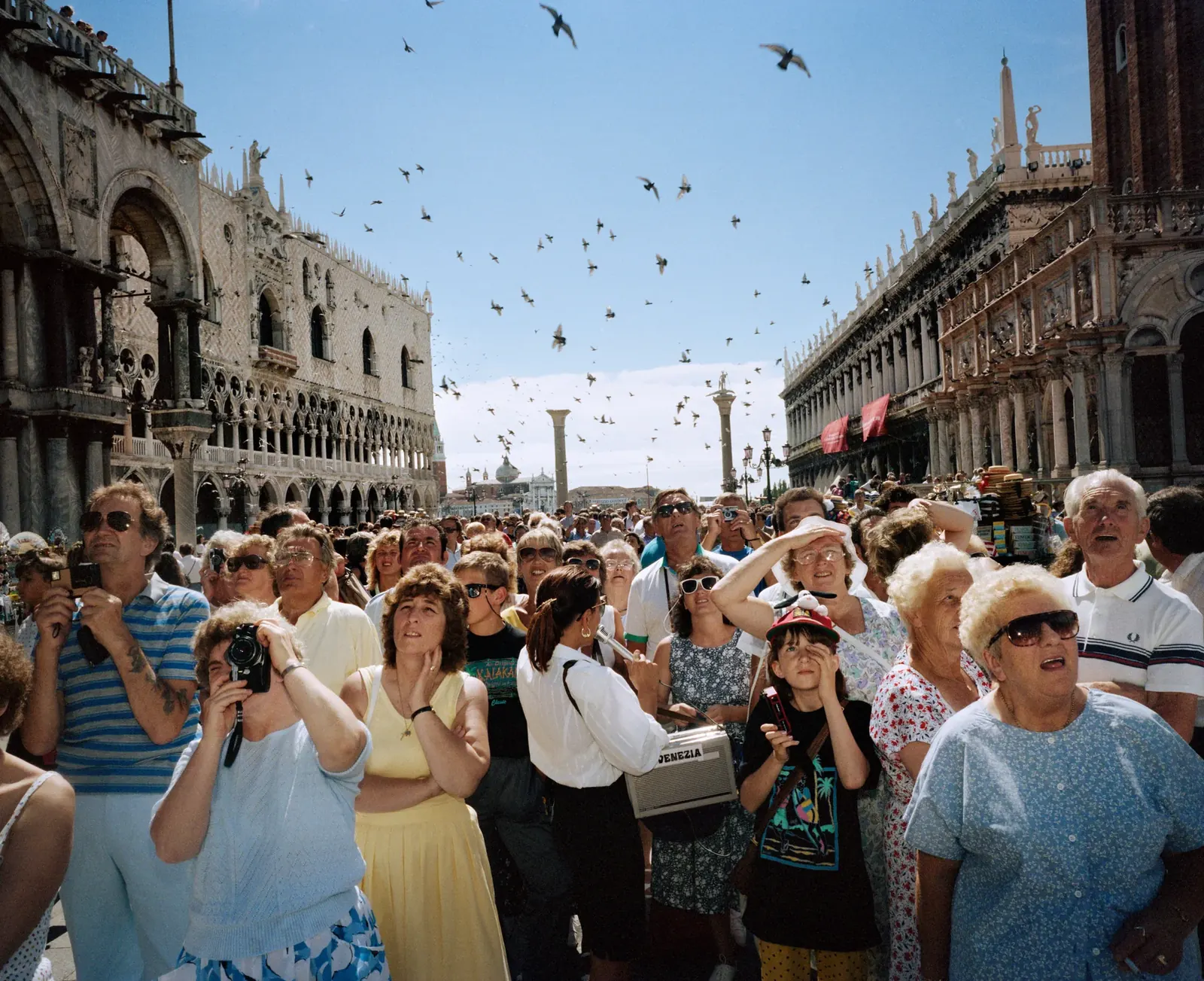
The eighties live in the comparison between Martin’s great photographs Parr which document the definitive affirmation of mass tourism in our country, between the beauty of the places and the bad taste of the visitors and those of Patrick Zachmann on the Neapolitan Camorra.
Contemporaneity, from the nineties to the first decade of the new century lives in the story of Alex Majoli on the discos of Romagna, of Thomas Dworzak on the G8 in Genoa, of Peter Marlow on the war in the former Yugoslavia and of Chris Steele Perkins on the “Clericus Cup”, the football tournament between religious.
The exhibition ideally closes with Paolo Pellegrin with the shots taken of the crowds gathered in St. Peter’s Square in Rome during the vigil for the death of Pope John Paul II and of a boat full of migrants in the Mediterranean Sea.
This journey through small and large events, specific or contingent moments, is an attempt to bring order, albeit partial, to our memory; to reread the past and the present to try to interpret the complex physiognomy of contemporaneity.