Exhibition
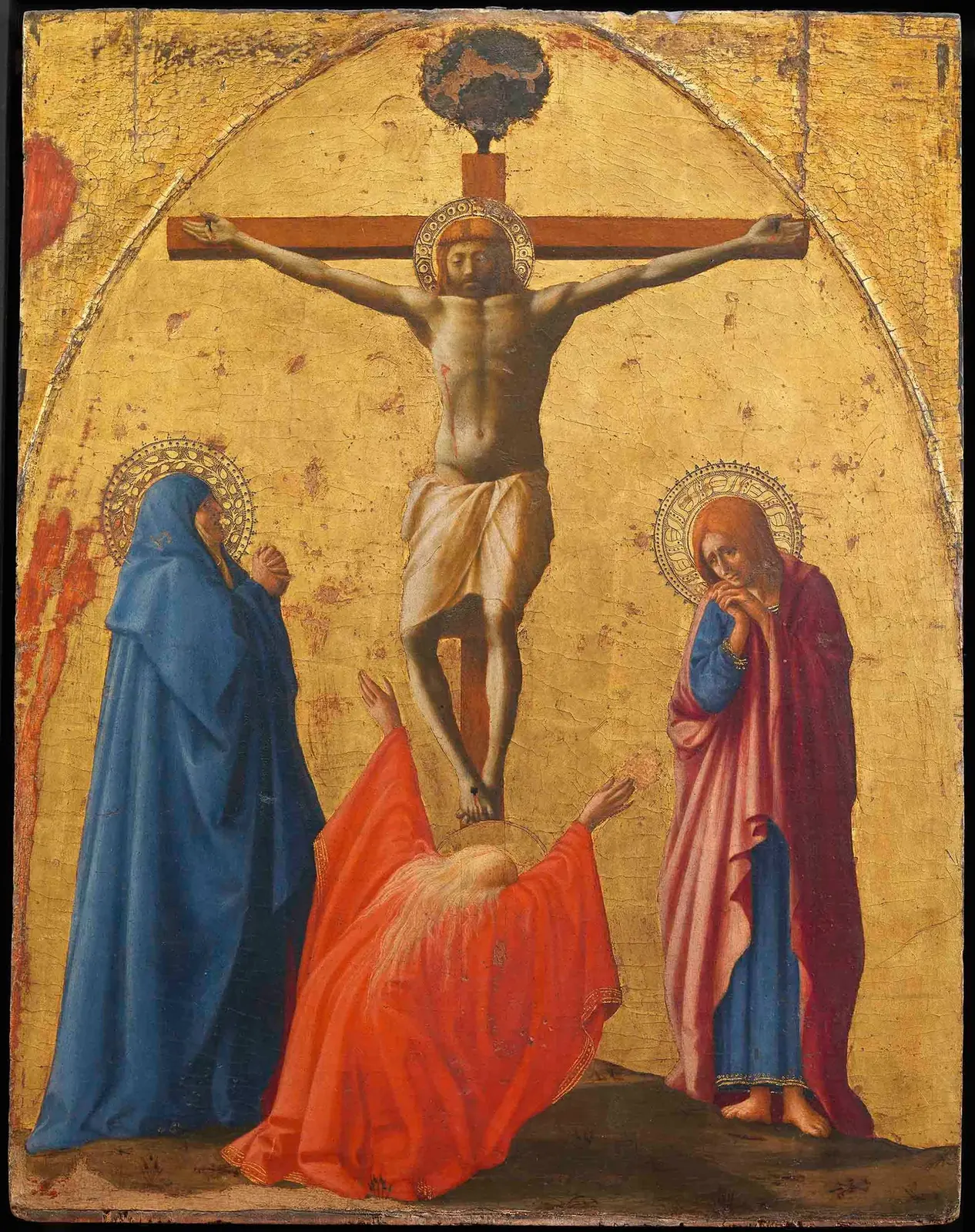
As a starting point for reflection during the season of Lent and Easter, the Museo Diocesano presents the display of the Crucifixion by Masaccio (San Giovanni Valdarno, 1401 – Rome, 1428): the precious panel, held at the Museo e Real Bosco di Capodimonte in Naples and in Milan for the first time, is one of the most important works by the Tuscan artist who, in his brief but dazzling career, revolutionised the history of art.
The display of a gold-ground work – the gold ground par excellence of Italian painting – is intended as a tribute to the memory of the jurist and collector Alberto Crespi (1923 – 2022), who bequeathed to the Museum his precious collection of Fondi Oro (gold-ground paintings).
The Crucifixion forms the crowning element of a grand polyptych created by the Tuscan painter in 1426, intended for a chapel in the church of Santa Maria del Carmine in Pisa and already dismembered by the end of the 16th century. In a space defined by the precious gold background and bounded by a pointed arch, the panel depicts the Virgin, Saint John the Baptist and the Magdalene mourning the crucified Christ. Masaccio interprets the drama by portraying a profoundly human grief, concentrating on only a few essential elements: the clenched hands protruding from the Virgin’s massive body; the hands raised to the face of the sorrowful, almost spectral Saint John; but, above all, the arms raised in an uncontainable surge of anguish by a faceless Mary Magdalene, kneeling with her back to us. Christ, depicted frontally, his head sunk between his shoulders – thus presupposing a viewpoint from below, rendered through a skilful foreshortening that also shortens the legs – succeeds in conveying the sorrowful humanity of a body abandoned to death. The figures, modelled with strong contrasts of light and shadow, are set in a real space despite the golden background, the stage for a dramatic event unfolding before the viewers’ eyes.