Exhibition
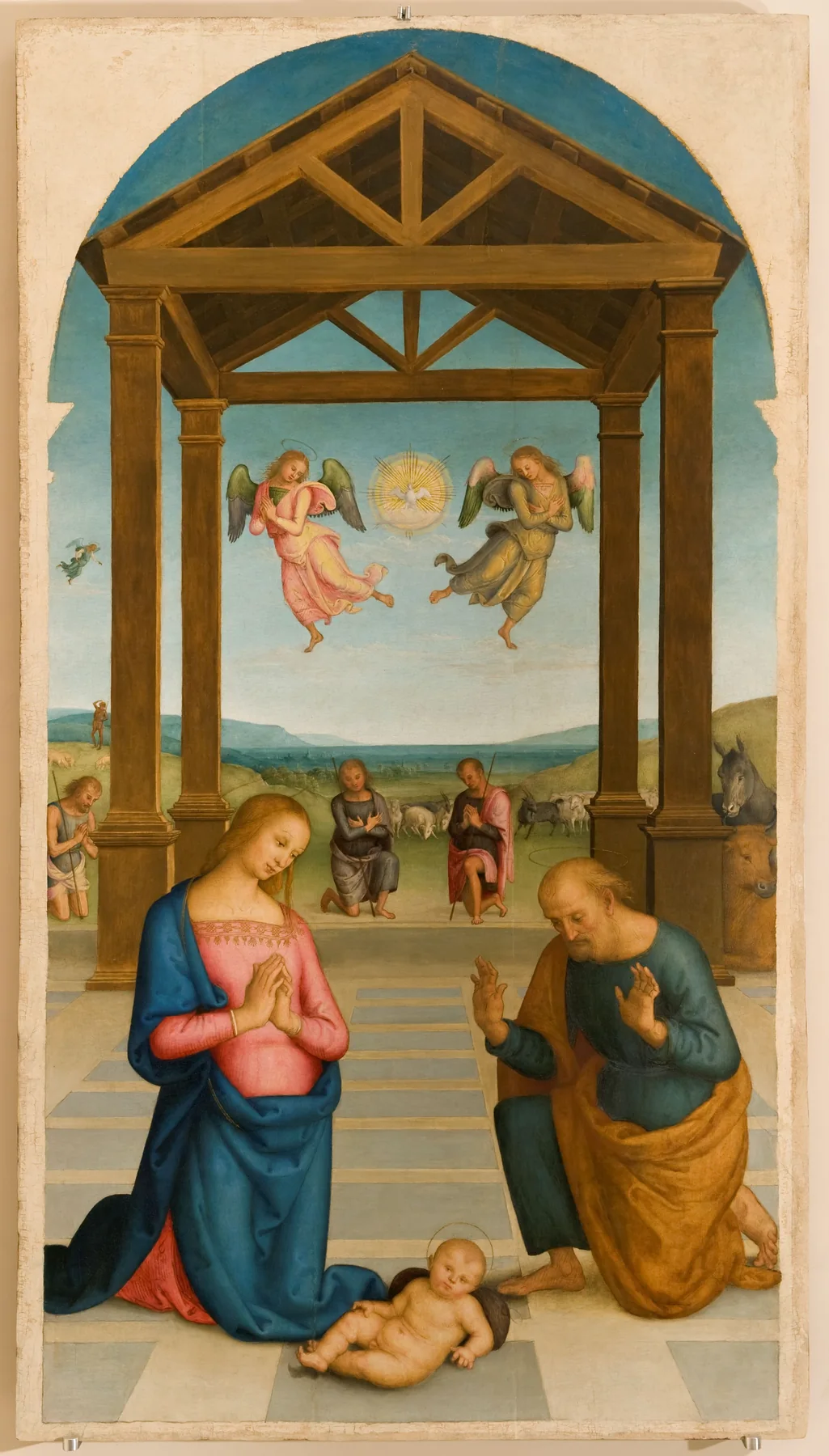
The Adoration of the Shepherds by Perugino is the Masterpiece for Milan 2017, a large panel from the National Gallery of Umbria in Perugia.
The initiative is curated by Nadia Righi, director of the Museo Diocesano in Milan and by Marco Pierini, director of the National Gallery of Umbria, with the patronage of the Archdiocese of Milan, the Pontifical Council for Culture, the Lombardy Region, the Umbria Region, the Municipality of Milan, the Municipality of Perugia.
The work is the undisputed masterpiece of Pietro Vannucci’s maturity, known as Perugino, and is part of a polyptych executed for the church of Sant’Agostino in Perugia, commissioned by the Augustinian friars in 1502.
Its complex execution took more than twenty years and, at the painter’s death, some finishing touches were still missing. It was in fact a grandiose altarpiece, with multiple compartments and multiple registers, which must have been more than eight meters high and which was made up of over thirty panels.
As early as 1654, the imposing structure, unsuited to the new liturgical requirements of the Counter-Reformation, was dismantled and divided into two parts. The panels then began to disperse. Many are now in France following requisitions by Napoleon’s troops in 1797, or in the United States, such as the Saint Bartholomew in Birmingham, Alabama. Others remain in Perugia, including Christ Supported by Nicodemus between the Grieving Virgin and Saint John the Evangelist in the Benedictine church of San Pietro.
Alongside the Adoration of the Shepherds, the Galleria Nazionale dell’Umbria retains panels depicting God the Father Blessing, the Prophets Daniel and David, the Archangel Gabriel, the Baptism of Christ, Saints Jerome and Mary Magdalene, together with twelve panels from the predella.
There have been numerous attempts to recompose the original structure of the large polyptych.
The exhibition project, curated by the architect. Alessandro Colombo of Studio Cerri & Associati will try to suggest the architectural space for which the work was intended and to evoke the grandiose polyptych of which it was part.