
Exhibition
The Museo Diocesano presents a retrospective devoted to Robert Capa, retracing the main stages in the career of the war photographer, from his beginnings in 1932 to his death in 1954 in Indochina, when a mine exploded.
An exhibition of 300 works, selected from the archives of the Magnum Photos agency, that sets out to reveal the temperament and many facets of a passionate and elusive figure – insatiable and perhaps never fully satisfied – who did not hesitate to risk his life for his reportage.
Henri Cartier-Bresson wrote of him: “For me, Capa wore the suit of lights of a great matador, but he did not kill; a fine player, he fought generously for himself and for others in a whirlwind. Fate decreed that he should be struck down at the height of his glory”.
The exhibition is arranged chronologically, offering a detailed look at the artistic and professional path of one of the most influential photographers of the twentieth century, exploring his most iconic shots while at the same time outlining the working method Capa used, from which emerge the rapport and empathy the photographer felt for his subjects – soldiers, but also civilians – on the battlegrounds where he mostly worked. In the curator’s intention, the project seeks to emphasise the humanist dimension of Robert Capa, the other angles towards which he turned his lens: the peoples who were victims of conflict, children and women.
Gabriel Bauret states: “If his war photographs shaped the legend of Capa, in his reportage we also see him looking at reality from different points of view, concentrating on what the photographer Raymond Depardon called ‘weak moments’, as opposed to the strong moments that usually mobilise journalists’ attention and require them to be the first and the closest”.
In these “weak moments”, personal stories emerge from universal History, and the individual is revealed in all his humanity.
The exhibition is organised into 9 thematic sections – Early Photographs, 1932–1935; The Hope of a Fairer Society, 1936; Spain: Civic Commitment, 1936–1939; China under Japanese Fire, 1938; Alongside the American Soldiers, 1943–1945; Towards a Regained Peace, 1944–1954; Journeys to the East, 1947–1948; Israel, the Promised Land, 1948–1950; Return to Asia: A War That Is Not His Own, 1954 – which evoke the reportage-style arrangement in which his photo-essays were published in the French and American press of the time.
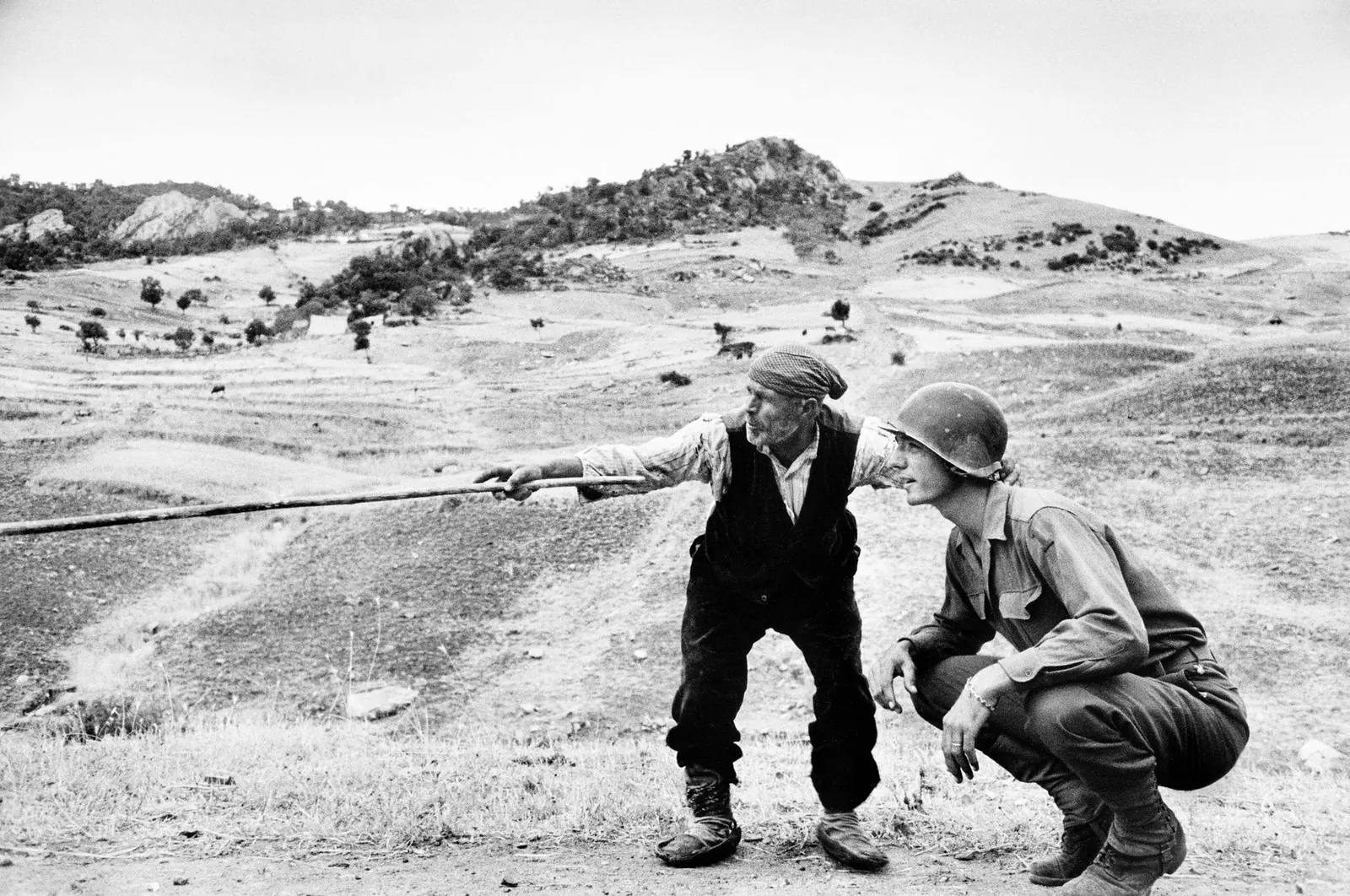
© Robert Capa © International Center of Photography/Magnum Photos