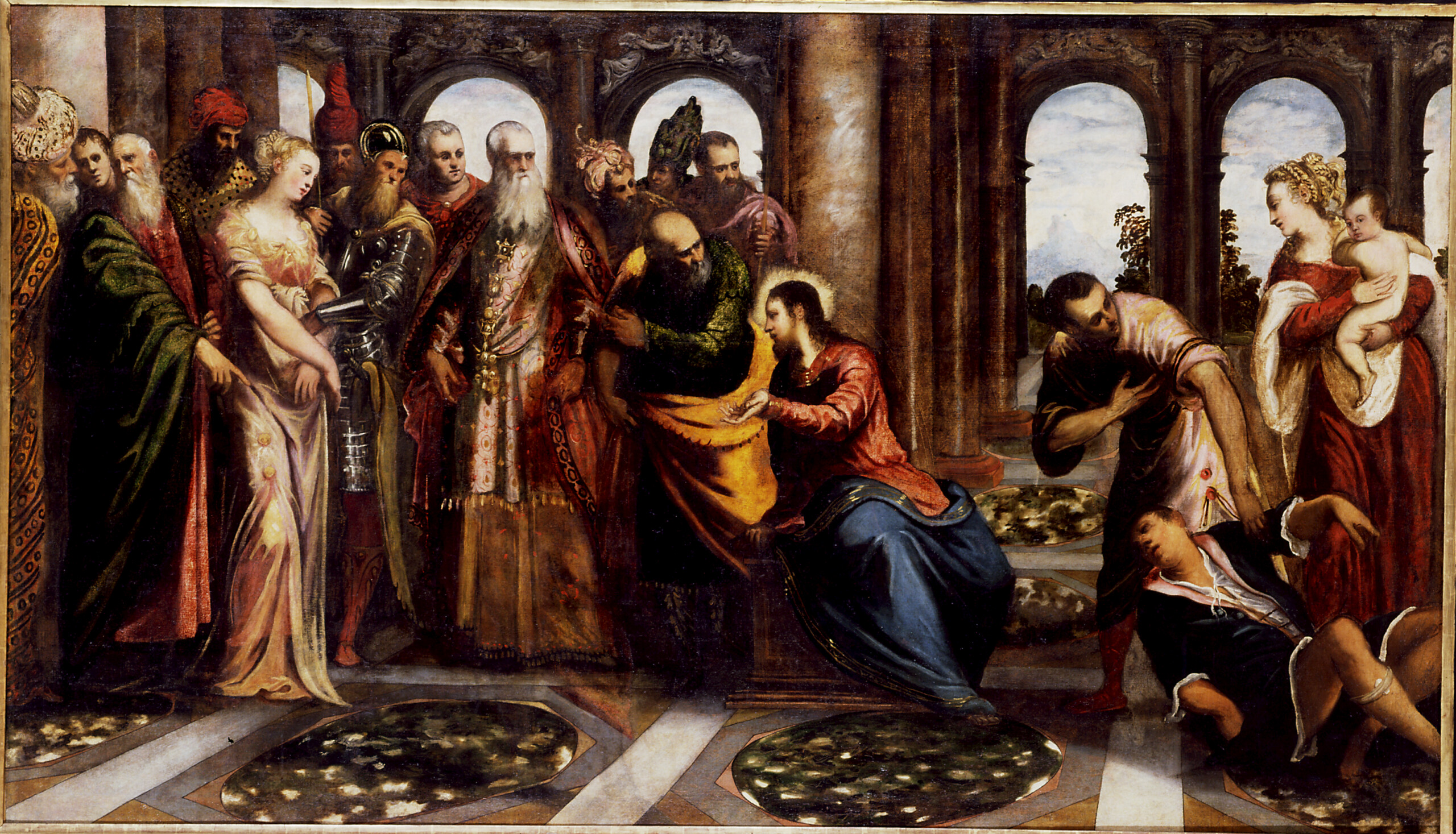
Christ and the Woman Taken in Adultery
Referring to Tintoretto’s youthful phase, the work can be dated around 1546-1547, at the moment in which the artist began his studies towards the narrative dramatization of subjects, one of the most characteristic elements of his language. Slight uncertainties in the perspective and in some executive details have also made us think of the intervention of the workshop, although other features, such as the strength of the face of the bearded character behind the courtesan, reveal the hand of the great Venetian painter. The characters are arranged in the composition as if on a stage that incorporates architectural solutions by Sebastiano Serlio, reinterpreted in a more free manner. The work comes from the Archbishop’s Picture Gallery and is part of the collection of Cardinal Cesare Monti (1593-1650).
Audio
Artwork details
- Artist:
- Jacopo Robusti, detto il Tintoretto (Venezia 1519 - 1594)
- Title:
- Christ and the Woman Taken in Adultery
- Date:
- 1546-1547
- Medium and technique:
- oil on canvas
- Dimensions:
- 164,5 × 283,5 cm
- Inventory:
- MD 2001.048.041
- Location
-
Location: Monti Collection, first floor
The Monti Collection comprises a group of paintings and drawings from the Archbishop’s Picture Gallery that reflect the collecting choices of Cardinal Cesare Monti (1593–1650). These were fully in keeping with the culture of Saint Charles Borromeo and the spirit of the Counter-Reformation: art, and painting in particular, was intended to encourage virtue and moderation among the faithful. The cardinal’s choices focused especially on the sixteenth-century Venetian school, painters active in Lombardy in the early seventeenth century, the followers of Leonardo and the Emilian school.