Reliquary Cross
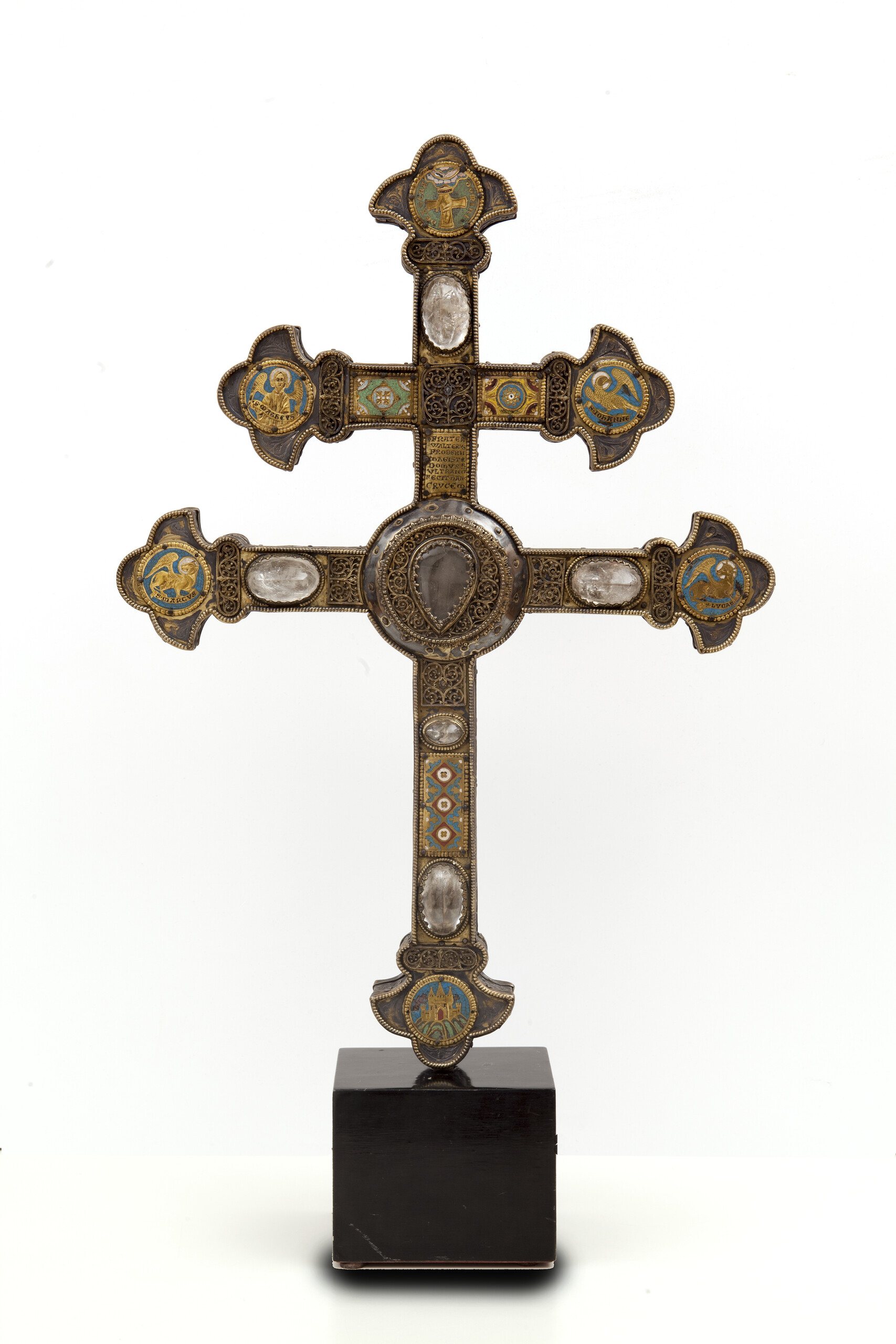
Dating to the first half of the 13th century, the cross comes from an area between the ancient Netherlands and northern France, and was intended to preserve the relics of the True Cross. An inscription leads it back to the city of Utrecht, suggesting interesting hypotheses about the commission: a small plaque on the front bears an inscription that alludes to a ‘frater magister’ of a ‘domus’ in Utrecht which would suggest a commission linked to a chivalric order and in all likelihood the mysterious building on the medallion must also be read in relation to the inscription.
The typology is that of a crux gemina, that is, a cross with a double crossbar, a form of Byzantine origin commonly used to contain the relics of the True Cross; the lily-shaped endings were especially widespread in northern and central France and in the area between the Meuse and the Sambre. The presence of the thorn indicates that originally there was the possibility of inserting the cross on a pole or in a base: the work therefore probably had a triple function: reliquary of the True Cross, processional cross and non-stationary altar cross. On the ends of the arms and the upright there are medallions with the symbols of the Evangelists and the hand of God. The remaining parts of the cross contain decorative enamels, filigree elements and rock crystals.; the rest has an aniconic decoration with cloisonné blue-turquoise enamel elements. The work belongs to the Schubert Bequest, a small group of works bequeathed to the Museum by the Schubert family in 2014.
Audio
Artwork details
- Artist:
- Bottega dell'Europa Nord-Occidentale (?), prima metà del XIII secolo (?)
- Title:
- Reliquary Cross
- Date:
- c. 1200-1250
- Medium and technique:
- Silvered copper, filigree, champlevé enamel, cloisonné enamel, niello (?), rock crystals
- Dimensions:
- 63, 8 × 45 × 4,5 cm
- Inventory:
- MD 2014.178.004
- Location
-
Location: Schubert Collection, first floor
The Schubert Collection consists of a small group of works bequeathed to the Museum in 2014 by the Schubert family, for many years a leading name in the Italian and international antiques trade. The precious works come in particular from the collection of Gualtiero Schubert (1915–1990). His wife, Letizia Castelli Schubert (1921–2013), who shared his passion for the visual arts, chose to leave them to the Diocesan Museum.