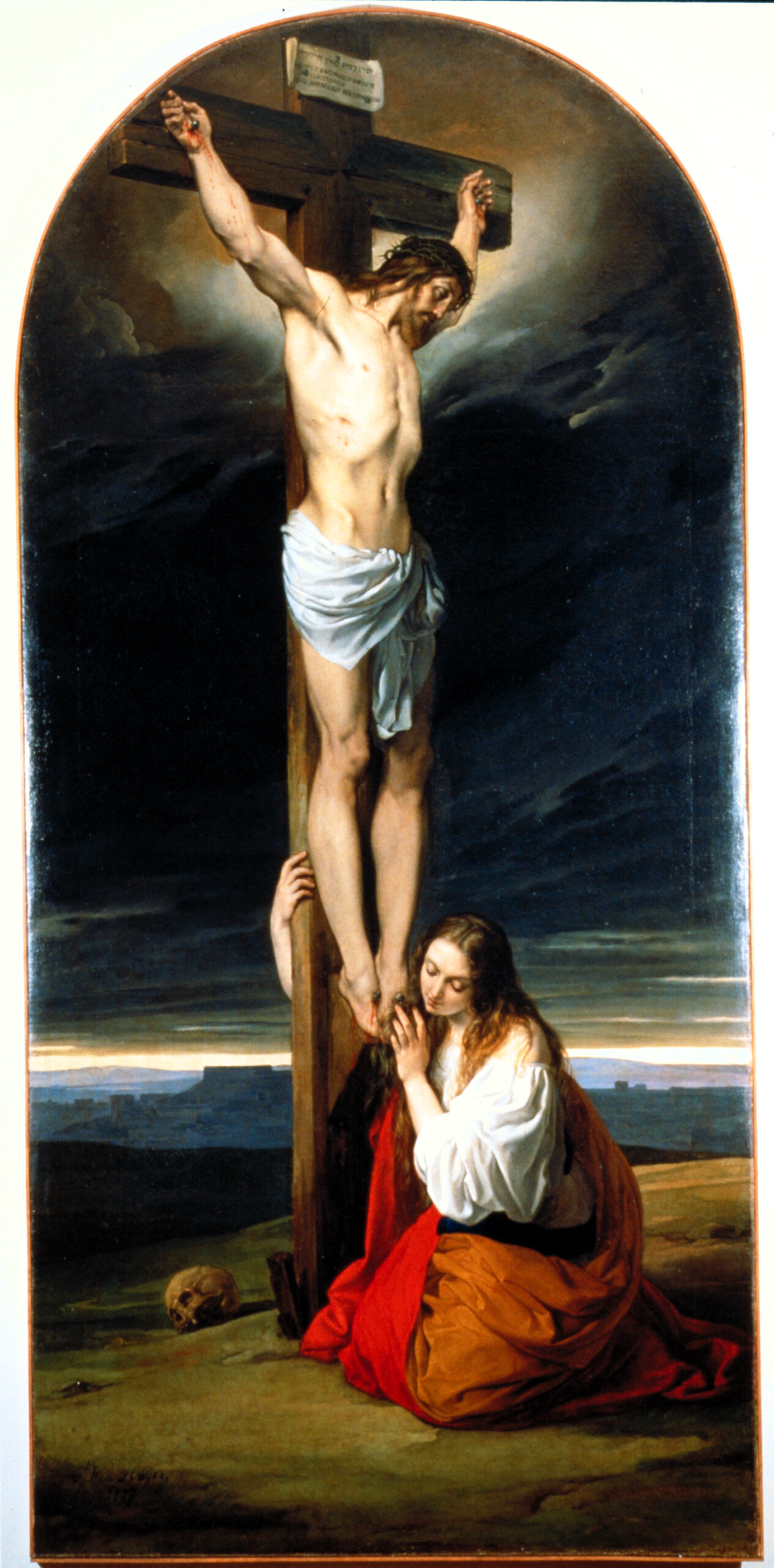
Christ Crucified with Mary Magdalene Kneeling and Weeping
Dated to 1827, the painting was commissioned by the Isimbardi Casati family, lords of Muggiò, for the town’s parish church, its original location; it is one of the rare works of public destination and of a religious subject created by Hayez, protagonist of Italian pictorial romanticism. The traditional iconography of the Crucifixion is interpreted here in a typically romantic key, with a careful and balanced composition. The two protagonists are immersed in an absolute silence which accentuates the evocative strength of the moment and the intensity of a universal pain, sublimated in the beauty of the form. There is no shortage of echoes of Caravaggio, particularly in the figure of the Magdalene, and references to Titian’s naturalism, an essential point of reference for the artist. The painting came to the Diocesan Museum from the Archbishop’s Picture Gallery.
Audio
Artwork details
- Artist:
- Francesco Hayez (Venezia 1791 - Milano 1882)
- Title:
- Christ Crucified with Mary Magdalene Kneeling and Weeping
- Date:
- 1827
- Medium and technique:
- oil on canvas
- Dimensions:
- 220 × 103,7 cm
- Inventory:
- MD 2001.056.001
- Location
-
Location: Works from the Diocese, first floor
The core of the Museum’s collection consists of works from numerous churches across the vast territory of the Archdiocese of Milan, an area of great cultural and artistic richness. Before the Museum opened in 2001, surveys and site visits throughout the diocese uncovered treasures that had, in some cases, previously been unknown, and initiated a programme to recover, restore and promote this artistic heritage. The selected works included panel and canvas paintings, wooden and marble sculptures, and liturgical furnishings. These were not objects of local devotion and mostly had conservation problems, and were therefore restored, or were at risk of theft. The works are arranged chronologically, beginning on the ground floor and continuing along the central corridor on the first floor; some are displayed in the hypogeum. This core is complemented by other works that have entered the Diocesan Museum’s permanent collection over the years through loans, donations and bequests.
Related artworks