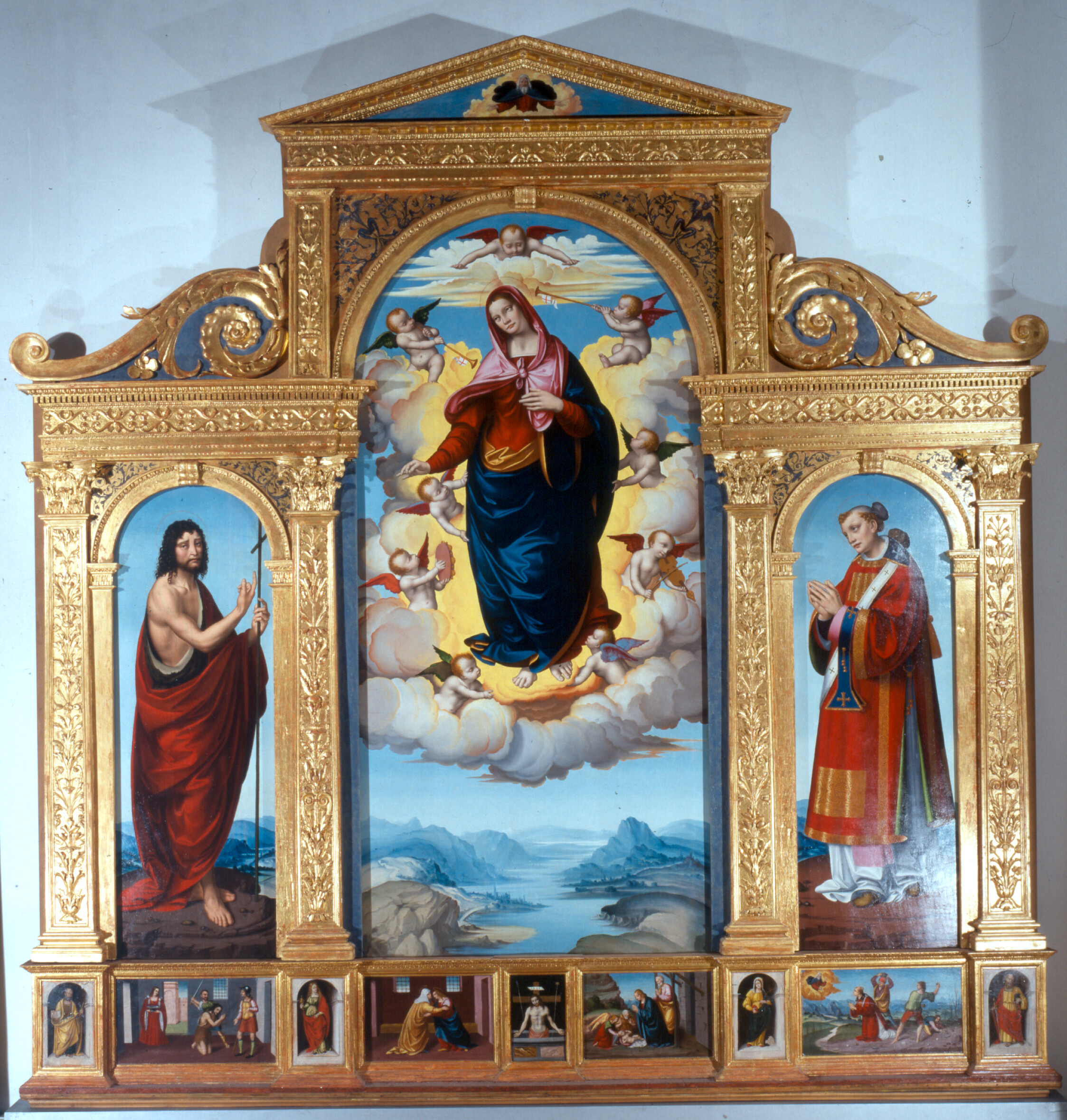
The Assumption of the Virgin with Saints John the Baptist and Stephen
Dating to around 1510 and coming from the church of Santo Stefano di Mezzana in Somma Lombardo (VA), the polyptych is the only multi-panel complex that is fully preserved and still inserted in the original gilded wooden carpentry referred to Marco d’Oggiono, a direct pupil of Leonardo da Vinci. The three main figures, characterized by a typically sixteenth-century monumental rendering, dominate the space behind, a lake landscape rendered with an aerial perspective clearly derived from Leonardo. The panels of the predella, which depict the Beheading of the Baptist, the Visitation, the Nativity and the Martyrdom of Saint Stephen, with the Imago pietatis in the centre, are separated from each other by panels with figures of saints. The scenes present a strong narrative accent and an almost miniaturistic taste that frequently appears in the artist’s production.
Audio
Artwork details
- Artist:
- Marco d’Oggiono (Oggiono (LC) 1470/1475 – Milano 1524)
- Title:
- The Assumption of the Virgin with Saints John the Baptist and Stephen
- Date:
- c. 1510
- Medium and technique:
- Oil and tempera on wood
- Dimensions:
- 350 × 420 cm
- Inventory:
- MD 2001.089.001
- Location
-
Location: Works from the Diocese, first floor
The core of the Museum’s collection consists of works from numerous churches across the vast territory of the Archdiocese of Milan, an area of great cultural and artistic richness. Before the Museum opened in 2001, surveys and site visits throughout the diocese uncovered treasures that had, in some cases, previously been unknown, and initiated a programme to recover, restore and promote this artistic heritage. The selected works included panel and canvas paintings, wooden and marble sculptures, and liturgical furnishings. These were not objects of local devotion and mostly had conservation problems, and were therefore restored, or were at risk of theft. The works are arranged chronologically, beginning on the ground floor and continuing along the central corridor on the first floor; some are displayed in the hypogeum. This core is complemented by other works that have entered the Diocesan Museum’s permanent collection over the years through loans, donations and bequests.
Related artworks